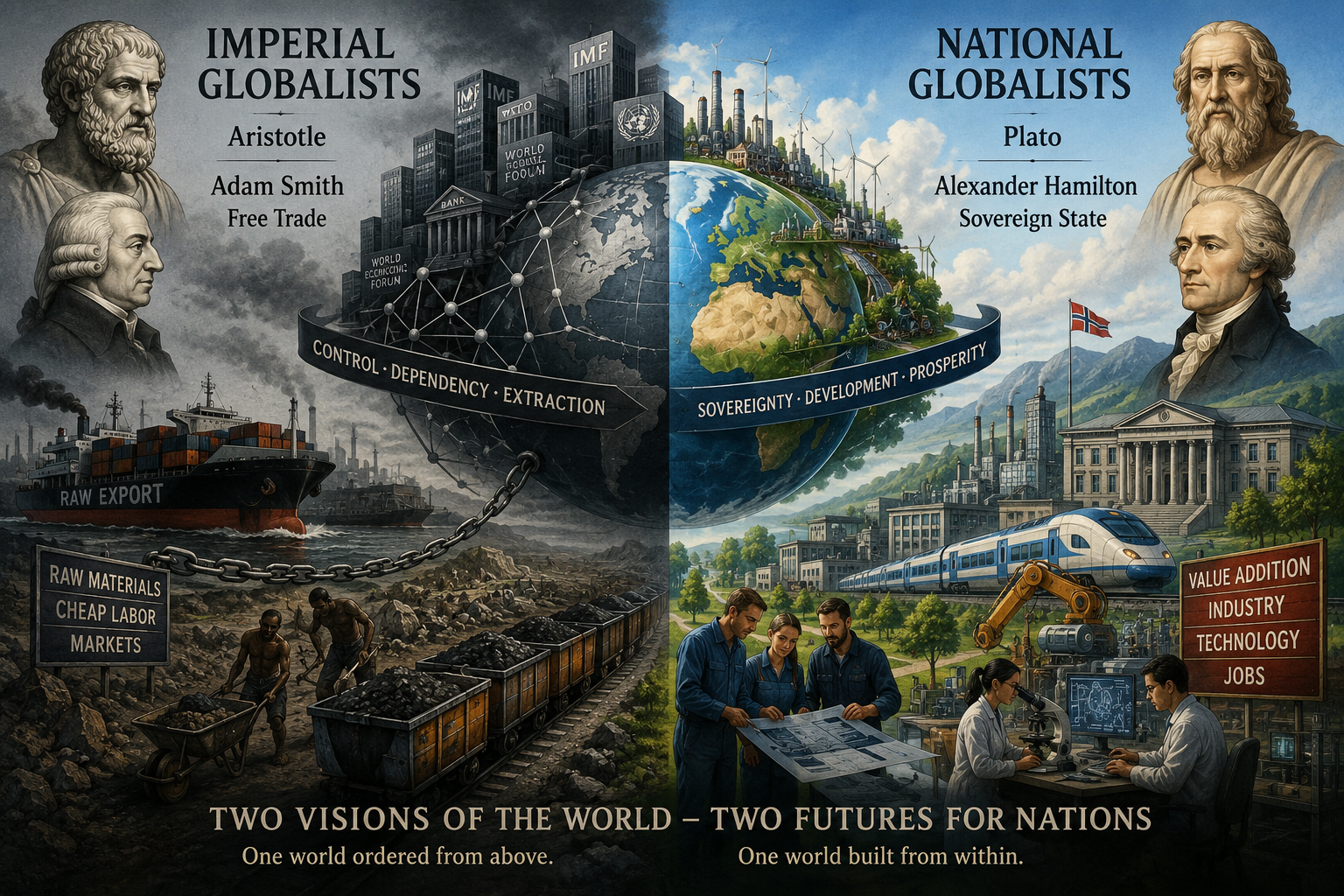
 Imperial globalists are defined as actors who want a global governance model in which power is concentrated in supranational systems, empires, great-power blocs, financial networks, technology platforms, and international institutions. Their thinking is based on the idea that nations should be integrated into larger economic and political systems, often as suppliers of raw materials, labor, or markets for stronger powers. In practice, this can weaken national sovereignty and make countries dependent on global value chains they do not control themselves.
National globalists are defined as actors who want a global cooperation model in which sovereign nation-states trade, negotiate, and cooperate internationally without giving up control over their own development. National globalists are not isolationists. They want nations to participate in the world, while also building their own industry, refining their own raw materials, developing their own technology, and retaining democratic control over laws, borders, the economy, culture, and security.
The imperial globalists are linked to Aristotle’s more biological and socially ordered view of humanity, where the human being is understood as a political animal that finds its place within a larger hierarchical community. In modern form, this can become a systems-oriented way of thinking in which people and nations are reduced to functions within a larger order: some produce raw materials, while others control capital, technology, and rules. When this logic is globalized, the world is organized as a hierarchy between center and periphery.
In economic history, the imperial globalists are linked to Adam Smith’s free-trade thinking. Smith is associated with the spontaneous order of the market and the idea that trade across borders creates prosperity. But in an imperial context, “free trade” can become a tool for strong powers. Countries that already control capital, fleets, finance, industry, and technology can use open trade to keep weaker economies locked into the role of raw-material exporters. In that case, free trade is not equal cooperation, but imperial globalism disguised as the market.
The national globalists, by contrast, are linked to Plato and the idea of the creative and unique human being. In Plato, there is the idea that the human being has a soul, creative power, and the ability to rise above the purely material. Applied to the nation, this means that a people should not merely adapt to a place within a global system, but develop its own potential. The nation should not merely sell raw materials cheaply and buy finished goods expensively. It should refine its own resources and build knowledge, industry, technology, and culture.
This becomes especially clear in Alexander Hamilton. He believed that a young and sovereign state had to protect and develop its own industry, finance, infrastructure, and strategic capacity before it could compete freely with stronger powers. For Hamilton, the state was not an obstacle to economic development, but a necessary instrument of national strength. This is the core of national globalist thinking: countries should trade with the world, but not give up control over their own development.
The difference between imperial globalists and national globalists is therefore not whether one is for or against global contact. The difference is what role the nation should have in the world. Imperial globalists place nations into a global division of labor in which weaker countries often export raw materials, while stronger countries control refining, finance, and technology. National globalists want nations to rise through the refinement of their own raw materials, national industry, knowledge, and democratic governance.
In summary, imperial globalists want to integrate nations into a global system. National globalists, by contrast, want nations to participate in the world as free, creative, and sovereign communities.